Wednesday, August 3, 2011
Just a progress update really
Now that the shearing is completed, I've made sure to clear the shearing shed out as quickly as possible. I had the carrier come in a few days later and take all the wool bales off to the wool stores in Adelaide, ready for sale. And then the local wool buyer come round to collect all the odds and sods that didn't fit in with the main lines of wool.
It was necessary to clear the wool out as soon as possible as we have quite a bad mouse plaque here at the moment. They were quite plentiful in the shearing shed, and they will eat through just about anything, including wool bales, if they think they may find something to eat in there. They potentially could do a lot of damage very quickly. So the wool was moved out at the earliest convenience.
Mice also do a lot of damage out in the paddocks, with the young crops trying to get a foothold in the cool conditions, the mice have done a fair bit of damage in some paddocks, to the point where I'll have to re-sow some crops.
It's also time to start looking at the crops to see what weeds are also coming up in them, and planning a spraying program to try and keep them under control. The first up is grass sprays in out canola crops. Grass sprays remove rye grass and other grasses as well as volunteer cereals (wheat or barley) that may also germinate.
The weather has been quite dry since seeding, with only a few quite minimal rainfall events. We are lucky in that we have had some quite heavy falls earlier in the year, so the sub-soil moisture levels are really quite high, so, at this stage, it should still be all good.

Thursday, July 21, 2011
Back into it now holidays are over
It's been great to have a week off with the family but time stops for no man and neither does the farm work. So it's been straight home from holiday and into the shearing shed. Our July shearing run started Monday and will run through until tomorrow (Friday). It takes a little to organise for shearing. Mobs of wooly sheep need to be moved up to the shearing shed and held in the sheep yards to empty out, and dry out if it's been raining. The shearing shed needed a bit of a tidy up too, there was still a bit of wool left around the place from the last time we used the shed. On Monday the 2 shearers pulled in and started at the normal start time of 7:30. half way through the second day on of our shearers had to pull out due to tendonitus in his arm, so I had to take over with the hand piece and shear a few myself. Not a problem.. as farmers are known to be jack of all trades.. (but masters of none). Well it's smoko time now.. better go organize myself a quick cuppa.
Thursday, July 14, 2011
Seedings all done, good chance to take a break
Finally I'm finished seeding and, well, most of the crops are coming up nicely and at this stage looking like a promising season. I always get very nervous during the time it takes from planting the seed til it actually comes up... cause ya always wonder if it's actually going to. So what better time to take a break and spend a bit of quality time with the family. I think they'd almost forgotten what I looked like, so it wasn't before time.. even got a chance to get over to the big smoke and have a bit of a look around. I'll be back on the land soon and we'll start our July shearing then.
Thursday, June 23, 2011
Still seeding, but we're gettin there
Still seeding here, but we're not too far from the end now. All the wheat has been planted, I should finish the barley in the next coupla days, leaving only the peas still to plant. So by this time next week I'm hopin it'll be all done and dusted. I've been pondering lately the importance of what I'm putting in the ground. Ya see, the seeds that I plant are the seeds that will grow - sounds pretty basic really doesn't it? I don't want to be planting wheat, for example, that has been contaminated with other seeds, such as peas or even weed seeds. I didn't mention in earlier posts that before we plant any seed we get the local seed grader to come around and clean all our seed to ensure its quality and purity for planting. I find my life is a bit like that too... just like the seeds that I'm putting in the ground I need to make sure what I'm putting into my life is high quality and pure. If the seeds I sow into my life come from bad influences say on the internet or tv, bad music, even less than desirable friends, I will only reap greed, jealousy, anger, violence etc. But when I sow good positive things into my life I reap love, joy, peace, patience, kindness etc. So just like the crops I'm planting in my paddock, in life I will only reap what I sow.
Friday, June 10, 2011
seeding

Well seeding is still underway with plenty of wheat being planted at the moment. I grow 2 varieties of wheat.. Mace, which is a general run of the mill bread wheat, and Hyperno, which is a durum wheat used for making pasta.

Now it's a generally well known fact, almost an unwritten rule, that farmers are never satisfied. They always have something to complain about and it usually relates to the weather. If it's not too dry then it's too wet. If it's not too windy, then it's not windy enough. If it's not too hot, then it's too cold etc. You get what I mean. It does apply to all facets of farming, but mainly weather because we are so reliant on it to produce a crop. Well it's my turn to complain now because after good early rains, we haven't had any to speak of in the last few weeks and so the soil has really dried out and gone quite hard making it really difficult to get the disks on the air seeder to penetrate into ground to plant the seeds. In fact in quite a few places I've seen seed sitting on top of the ground in the furrows. The worst paddocks are ones that we've had sheep grazing on, they tend to pack the soil down when it's damp leaving it hard as rock.
 Speaking of rocks, I've been dealing with quite a bit of solid limestone in paddocks lately, but I think I'll save that story for another day.
Friday, June 3, 2011
Seeding Continues
A few images from the tractor seat (yes I know the windows need cleaning)


 Yes it's full steam aheah with seeding out on the farm, and everything is running smoothly. The New-Holland TM155 tractor is pulling the Hardi 4228B boom spray which goes ahead of the seeder to spray out any weeds and also prevent more weeds from germinating. The chemicals we're using are paraquat, trifluralin and diuron (pron. die-you-on). With the rains we had earlier this year quite a few weeds had already germinated and had already been sprayed out with knock-down sprays. I'm operating the seeding unit.. a John Deere 8200 tractor pulling a Simplicity 9000 TBT air cart and a John Deere 2200 cultivator which I've fitted out with K-Hart disk modules. I also need to keep up the supply of seed and fertilizer to the air seeder. To do that I have a seed and super unit (or grouper) on the back of the Atkinson, and the Kenworth has been getting it's fair share of work too, ferrying fertilizer around from farm to farm. A quick calculation and I've worked out that I've covered about 740ha (1800ish acres) out of just under 2000ha (4940acres) the I plan to plant all up.


 Yes it's full steam aheah with seeding out on the farm, and everything is running smoothly. The New-Holland TM155 tractor is pulling the Hardi 4228B boom spray which goes ahead of the seeder to spray out any weeds and also prevent more weeds from germinating. The chemicals we're using are paraquat, trifluralin and diuron (pron. die-you-on). With the rains we had earlier this year quite a few weeds had already germinated and had already been sprayed out with knock-down sprays. I'm operating the seeding unit.. a John Deere 8200 tractor pulling a Simplicity 9000 TBT air cart and a John Deere 2200 cultivator which I've fitted out with K-Hart disk modules. I also need to keep up the supply of seed and fertilizer to the air seeder. To do that I have a seed and super unit (or grouper) on the back of the Atkinson, and the Kenworth has been getting it's fair share of work too, ferrying fertilizer around from farm to farm. A quick calculation and I've worked out that I've covered about 740ha (1800ish acres) out of just under 2000ha (4940acres) the I plan to plant all up.
Thursday, May 26, 2011
Yes that's right, I've finally got the air seeder together - all assembled, and we're up and running. Actually we've been up and running for the past week now and have clocked up just under 1000acres in that time. I put a few hectares of fiesta beans in first up, then onto the canola. I'm up to 188ha of canola planted so far. I've also done about 200ha of pasture sowing that the sheep will enjoy later on in the year. As is the case with any new equipment there is always teething problems for a start and once I got the loading and calibration figured out on the new Simplicity 9000 tow between box, the adjustment of the new K-Hart disk modules and coulters was the main problem. the disks had to run in the ground at just the perfect depth. This was a little hard to achieve, possibly because the dry ground was so hard, but possibly also that the spring tension on the press wheels was way out of wack. It's lucky canola seeds dont need to be very deep. Well with quite a few adjustments made, and a reasonable drop of rain I think we are all good. Oh except for one minor little incident where I found that a John Deere 8200 front wheel assist tractor would not pull a Simplicity 9000 tow between air cart and a John Deere 2200 cultivator with 40 K-Hart disk modules through knee deep sandy muddy clay where water has been laying. Yep I got her bogged down to the back diff. Pictures will be added later but let me just say she took some getting out. A lot of digging and help from another tractor to pull her out.
Thursday, May 12, 2011
The Air Seeder is nearly assembled
I know that I said it would only take a day or so to finish off assembling the new disk modules on the John Deere 2200 cultivator bar... but... well it has taken a little longer. Closer to a week actually. And it's nearly done now. We also took delivery of a 9000litre Simplicity air cart, and that had to be all wired and plumbed into the bar too, with an air kit to go on to carry the seed and fertilizer out to each and every double disk opener. This is all but done now, just waiting on a few parts to come in that didn't quite get here with the initial delivery. Once we're all set up, and the airseeder computer's all programmed ready to go, out seeding program for the year will get started straight away, with Canola being the first crops I plan to plant.
There have been a few things going on in the background too over the past few weeks. One of them being a lot of weed spraying. My brother has spent quite a bit of time on the boom spray trying to keep on top of all the "summer" weeds that have sprung up because of the big rains we had a while back. The other thing that I haven't mentioned yet this year is that the ewes have been lambing for the past probably 5 or 6 weeks. Usually I spend alot of time grain feeding the ewe mobs at this time of year, but because of the abundance of natural feed out in the paddocks I haven't had to do any feeding this year. In fact I haven't even been out in the paddocks to check the mobs of lambing ewes. Well lambing is a natural thing ya know... I hope they know what they're doing themselves. And I have noticed that there are lambs out in the paddocks with the ewe, so cant be all bad.
Thursday, May 5, 2011
It's all slowly coming together
This is a bit of an update on the last post where I mentioned that I'd had trouble delivering the last of our barley to Viterra, and how my "blended load" strategy hadn't worked. I also made mention of lakes in paddocks and water over the roads and the there was new farm eqipment on the way. You'll be happy to know that I have been able to deliver the last of the barley, but not to Viterra. They decided to reject the whole lot of my remaining grain on the grounds that it had animal feaces in it and they have a nil tollerance policy in this area. Thankfully I was able to take it directly to a feedlot at Meningie instead where 5000 angas beef cattle were very appreciative, and didn't seem to mind the odd hint of cow poop in there one bit. As far as water over the roads around here goes, I told of how 5inches of rain one night left lakes in paddocks and a number of roads under water. This would have been about 6 weeks ago. Well the roads are all open and dry again now, but I do still have 1 paddock with a slowly shrinking lake in it, with all sorts of bird life there enjoying the water. It is always exciting when new farm equipment arrives, and last week that happened. My new air seeder box, a Simplicity 9000, was delivered, as was 6 pallets of air seeder parts. These parts when assembled make up K-Hart disk modules and will replace the existing tyne arrangement on the bar. I have started the process of changing them over and at this stage all the tynes have been removed and 2/3rds of the modules are assembled and on the bar. In the next day or so I should have this finished so I can start seeding in the very near future
Thursday, April 7, 2011
The Water Is Slowly Receeding
I know it's been a coupla weeks since my last post, and it was a couple of weeks ago that we had the big rain event that gave us lakes where there once was paddocks, and rivers where there once was driveways. Well most of the water has gone now, and roads have re-opened. There is still one large lake covering the road... just down the road, and it is amazing to see the variety of birdlife that has made itself at home there. So two and a half weeks after we received 5 and a half inches of rain, I'm just starting to realize that that is a lot of rain.
So what's been happening on the farm??... Well I'm glad you asked. Frustration mainly. This frustration mainly revolves around delivering our last loads of barley from harvest to our Viterra terminal (where we take our grain once it's harvested). We finished our harvest in the first few days of March, but after the 1st of March we had to send off samples of grain for chemical residue testing prior to delivery. These tests took over two weeks to come back, and now that I can finally deliver my grain. The problem is that there is a nil tolerance on any animal feaces (ie. sheep or cow poo) in any load... and so far each load I have tried to deliver have been rejeceted for this reason. Let me just clarify that the barley we produce isn't for human consumption and also is shipped overseas. Any other farmer who delivers grain to any grain bulk handler knows what "blending loads" means.. well that hasn't worked for me either. I've resorted to running the whole load through a snail roller, which is a machine with two rollers pressed tight together. The grain runs down between the rollers and everything softer than grain, such as snails.. and poop, is pulverised. Lifting the auger up nice and high allows the wind to blow through the grain as it's augered into the truck and all the "contaminants" simply blow away. Tomorrow I'll find out if this will be good enough to pass inspection at Viterra.
Other exciting happenings include the collection of some of our fertilizer for the upcoming seeding season. So the other day I shot up to Ardrossan to collect three 25tonne loads of D.A.P. fertilizer.
I'm not sure if I've mentioned before, but we've got a couple of equipment upgrades in the pipeline, including a new airseeder box. We have a Simplicity 9000ltr tow between box on the way - I'll send pictures when it arrives. I'm also in the process of converting my existing cultivator bar from a tyne machine to a disk machine. The process has only got as far as the ordering the parts, but they should arrive at any moment and the conversion will then commence.
I have a lot of spraying going on at the moment too. The recent rains have meant that plenty of weeds have grown in the paddocks and so I've put my brother to work on the boom spray to take care of some of these weeds. So even though this is the "quiet time of year", I'm still flat out trying to get all the maintenance jobs out of the way before we have to start planting the crops for next year. This starts around the end of April, early May.
Thursday, March 24, 2011
When it Rains it Pours
We have taken a break from crutching the sheep this week due to a little rain event we had Sunday night. I think the weather bureau forecast between 5 to 10mm of rain for Sunday night, well we had more like 5 to 10inches of rain. I couldn't accurately measure it, but I'll estimate that we took out 5inches, that's 500points (or if you like the new language 125mm). Although we had steady rain most of the day Sunday the majority of the rain fell overnight Sunday night/Monday morning. We woke up to lakes in paddocks where we've never seen lakes before, roads under water and our driveway resembling more of a river than a driveway.
A number of local roads were blocked, but I haven't heard of any houses being flooded out (the Edithburgh Football Club may be the only exception to this).
Water is receding now, 4 days later, but some roads are still impassable and are now home to bird life previously unseen on the roads and paddocks, such as ducks and ducklings, black swans and Cape Baron Geese (which are common around the swamp that is near by).
 This is just a shallow lake. At least this road is still passable.
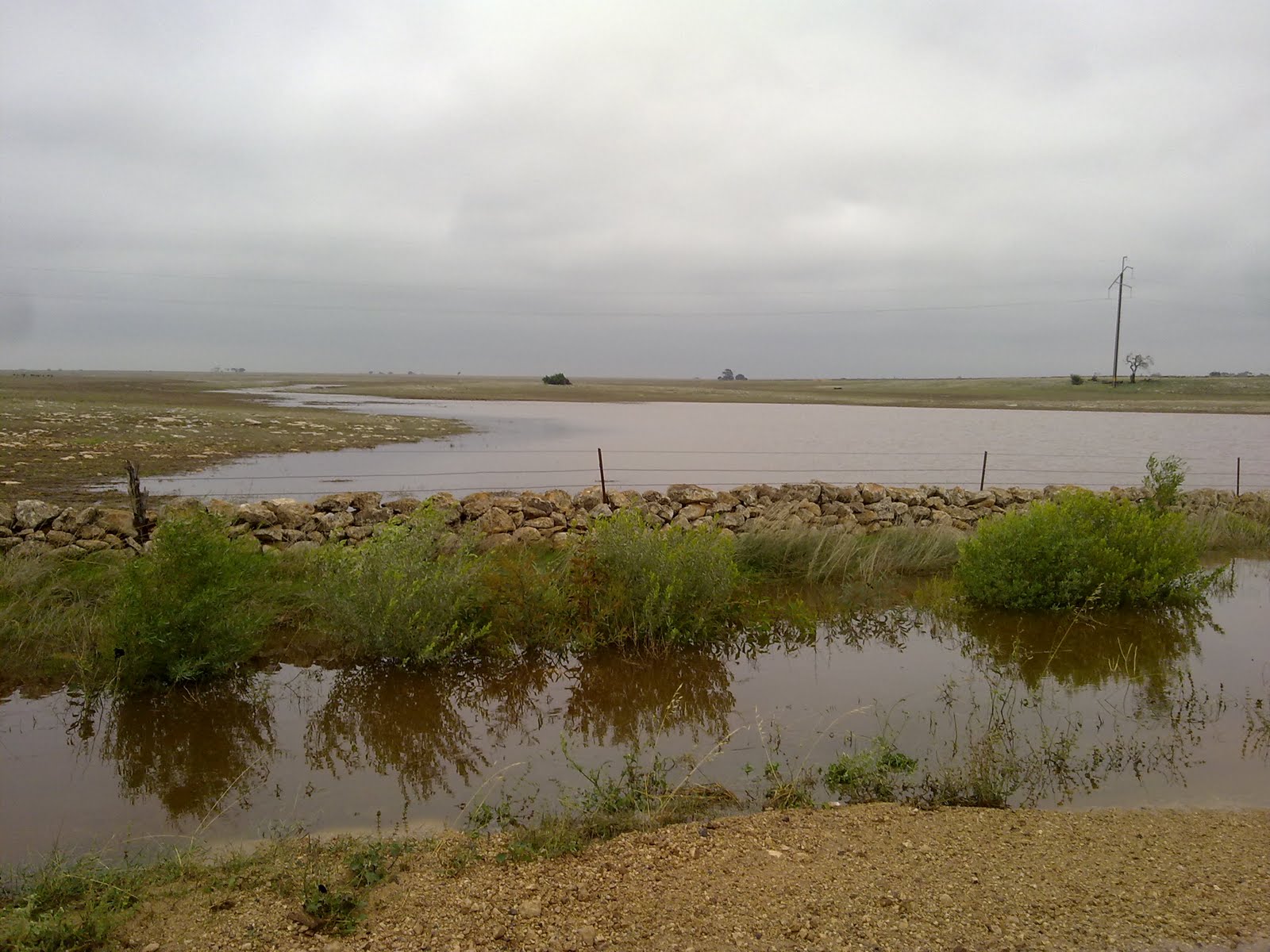 Here you see a river system running down into a lake that last week was our paddock.
 This is the neighbours paddock... ahhm I mean.. Lake.
 We have paddocks both sides here, but the only way we can check the sheep is with a boat.
 The lake in this photo actually runs right through the paddock on the right and crosses another road. At that point the water is actually deeper, with the fences and 5 foot high fence posts well and truly covered in water. The kids were able to get there swimming gear on and take there boogie boards down there for a bit of a swim... on the road.
Thursday, March 17, 2011
Crutching the Ewes
As soon as we could this week we got stuck into crutching the ewes (female sheep). They were quite a priority as they are due to start lambing in a few weeks, and so couldn't really be walked out of the paddocks to the shearing shed if we left it any longer.
This is a description of the crutching process, and I know that a picture is worth a thousand words, but as I was hard at it I couldn't really take any photos. So the process starts with tipping the sheep over and dragging them out of the catching pen backwards and position them next to the shearing equipment (the down-tube and hand piece). They are then given a dose of drench to kill any intestinal worms etc, and then the crutching itself begins. Crutching is similar the shearing in that wool is cut from the sheep using a handpiece. Starting with the head the wool around the face is first to go. The forehead (like the fringe) and on the sides of the face. This clears all wool from around the eyes so the sheep can see clearly, which will be important when they are mothering their new lambs in a few weeks time. They can become "wool blind" if the wool is left there and wouldn't be able to keep track of their lambs, and chances are the crows (which are evil animals by the way) would probably kill the lambs. Next I move down to the crutch area between the legs, and with the sheep still in the sitting position I take the wool off from the inside of one back leg, then a blow around under the udder to the inside of the other back leg. With the ewes getting close the lambing in a lot of them the udders are starting to enlarge so care needs to be taken not to nick of any skin around this delicate area. Quite often there is a small strip of wool that grows down between the teats (or nipples if you like) and that needs to be removed to give the young lambs the best access they can get to their precious food supply. Once the inside of both back legs are done I roll the sheep over to one side to do the backs of the legs and around the tail. I've got to be really careful around the backs of the legs because if the comb on the hand piece digs into the skin in that area there is a real risk of the hand piece catching the hamstring and cutting it. After doing one leg the area around the vulva, which is the external part of the reproductive system in female sheep, needs to be crutched, leaving no wool in the area at all - once again care needs to be taking in this delicate area of the animal. A blow over the top of the tail also clears this area up nicely. With the ewes so close to lambing it's important to have the area as clean as possible for the birthing process. I finish off the crutch with a blow down the back of the last leg, and one blow to tidy up the edge of the long wool that is left and then the sheep is let go out into the counting out pens.
We have four mobs of ewes, and we're working on the last one of them this afternoon.
Wednesday, March 9, 2011
The Long Harvest is Finally Over.
With great relief I am happy to report to you that harvest for the 2010/11 season is finally complete. On the 7th of March at 2pm the last row of windrowed barley was reapt. This is quite a bit later than the optimal finishing date, which would be early January. We had been waiting on the moisture to come down in the barley, to get it below the required 13.5% maximum, but when it come down we were into it again as hard as we could. The reason for pushing so hard in the end was that there was another rain even forecast... and we beat it! About an hour after we finished the rain started again. We only received around 9mm, but other areas in the state received quite a bit more.
So what's next? well I'm glad you asked. With the recent rains alot of weeds have germinated out in the paddocks. While some of the weeds are good weeds that provide good feed for the sheep, there are also paddocks with some quite nasty weeds which will need to be sprayed out before they get out of control.
The ewes will be due to start lambing in just over a month too, and with harvest being late, that means that we are now running late with other jobs. Crutching the sheep is a job that would usually be well underway by now, so the crutching is really quite a priority.
We are also looking down the barrel of this years seeding program, which should start around 6 weeks from now. We're changing over some of the seeding equipment this year so we'll need to start on the alterations pretty soon too, or we'll be running behind with that as well.
Wednesday, February 23, 2011
The Long Harvest
While most farmers in Sth Australia have finished their harvest for the summer, we are still plugging away at it. We only have about 90 hectares of windrowed barley to go, which would only take us a day or two, but with the recent wet weather, we've been held up yet again. Last Friday we received 89mm of rain, and as barley has to have a moisture content of no more than 13.5% when delivered, you can understand why we've taken a few days off.
And a few interesting stats from the harvest so far....
- we have reapt over 3000acres of various crops.
- the header has clocked up over 400 working hours
- I have delivered over 100 loads to the Viterra and GrainFlow sites in the area.
- The closest distance to a delivery site is approx 5km.
- The longest is about 85km. (that I have delivered to this harvest that is... obviously there are other sites further away).
- The Kenworth has clocked up over 15,000kms in the 3 months since harvest started.
We are now thinking about options to make harvest next year a lot faster. The possibility of a new combine harvester has come up.
Subscribe to:
Posts (Atom)